
Imagine treating a stubborn stage 4 sacral pressure injury. Despite meticulous offloading, proper nutrition and frequent changes with a standard hydrocolloid, the wound bed completely stalls. It’s clean with no signs of infection, but the tissue is still pale pink, not the vibrant, beefy red granulation tissue you want to see.
In this chronic phase, a bovine collagen dressing acts as a temporary scaffold. When applied, the body’s fibroblasts migrate into the collagen structure, encouraging the development of new, healthy tissue. It essentially provides the raw building blocks the body is struggling to produce on its own.
Bovine collagen offers a concentrated supply of the necessary protein to jumpstart the repair process. The deep red, granular tissue you’re looking for replaces the pale pink. It’s almost like flipping the healing switch. You’ll see a significant decrease in depth and smoothly contracting margins.
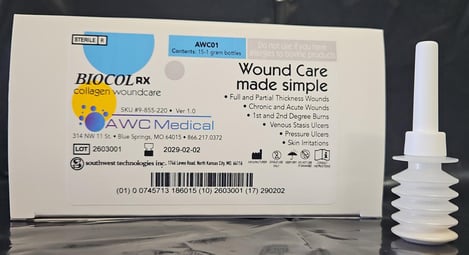 Targeted wound care
BIOCOL™ is a bovine collagen powder that interacts with the wound to form a gel, provide a moist wound healing environment, reduce inflammation and promote cellular regeneration. It contains 100% hydrolyzed collagen and supplies nutritive proteins and amino acids directly to the wound site. BIOCOL maintains moisture, stimulates wound healing, reduces wound discomfort/pain, and increases granulation tissue for complete wound closure without disturbance from excessive movement, irritation or rubbing.
BIOCOL’s advanced accordion dispenser delivers collagen precisely where you need it to promote a moist wound healing environment. It supplies nutritive proteins and amino acids directly to the wound site and easily reaches deep into tunneling or undermined wounds.

Key differences in bovine collagen powders for wound care
- Source and processing: Some powders are from bovine cartilage, while others are from bovine dermal sources. The processing, particularly hydrolysis, breaks the collagen down into smaller peptides, which are more easily absorbed and can be formulated for better application.
- Collagen types: While all bovine powders contain collagen, they may have different concentrations of specific types. For wound healing, Type I (providing tensile strength) and Type III (providing an initial scaffold for new tissue) are particularly important.
- Formulation and application: Some products are single-source collagen, while others are complex mixtures designed to integrate with other biomaterials or form a gel upon contact with wound exudate. Powders are often preferred for their ability to conform to irregular wound surfaces and absorb excess fluid.
- Specific product properties: Different formulations can have varying properties like antimicrobial activity or the ability to support cell proliferation and migration. Clinical studies often compare specific products with different compositions to evaluate their wound-healing efficacy.
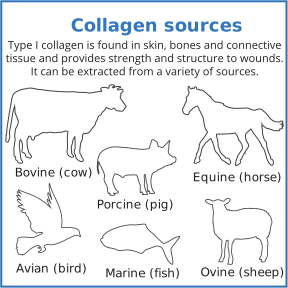
Advantages of bovine over other collagens
Because bovine collagen is chemically similar to human collagen, the body is less likely to reject it. Studies show that it speeds up key processes like fibroblast migration, new blood vessel formation (angiogenesis) and collagen deposition in the wound bed. It helps stop bleeding by activating platelets at the wound site to form a clot.
Collagen dressings can absorb excess exudate while keeping the wound bed moist, which is crucial for healing. It can also reduce the frequency of dressing changes, which minimizes trauma to the wound and can be more cost-effective.
Advantages of hydrolyzed collagen
- Easier, faster absorption: The hydrolysis process breaks down large collagen proteins into smaller, low-molecular-weight peptides, making them more soluble and easier for the body to absorb and use.
- Improved cellular activity: Once absorbed, these peptides can help attract fibroblasts to the wound and encourage the formation of new collagen. It bypasses the body's natural – and sometimes slow – enzymatic breakdown of native collagen. This is especially helpful in patients with comorbidities that may impair this process.
- Faster wound closure: Studies have shown that hydrolyzed collagen can lead to faster wound closure rates and improved epithelialization, where new skin covers the wound bed.
- Consistent source of collagen: An already processed form of collagen ensures a readily available supply for the wound, which is crucial for healing, especially in chronic wounds.
Learn more
For more information about BIOCOL or any of our wound care products, contact your Impact Medical sales representative or clinician.


